Spectro-astrometric Analysis#
With a given dynamical BLR model, it is easy to calculate its spectro-astrometric signals. Let us denote the projected coordinates of BLR clouds on the sky as \((\alpha, \beta)\), then spectro-astrometry \(s_\lambda\) along a direction \((u_\alpha, u_\beta)\) (e.g., spectral slit or interferometric baseline) is
where \(\lambda\) is wavelength, \(f_\lambda\) is the line flux ratio relative to the underlying continuum flux.
For spectro-inteferometry, the measured quantity is differential phase \(\phi\) (in degree), which is realted to astrometry as
where \(B\) is the sky-projected length of the baseline.
To compute the sky-projected position of BLR clouds, there involves a quantity called position angle \(PA\) of the BLR symmetry axis. If we create a left-handed Cartesian coordinate frame for BLR clouds, in which the \(x\)-axis is along the line of sight and positive x-axis points to the observer (see BLR Models), then the sky-projected position of a BLR cloud with coordinates \((x, y, z)\) is
brains read input spectro-astrometric data and fit \(f_\lambda\) and \(s_\lambda\)
to constrain the model parameters.
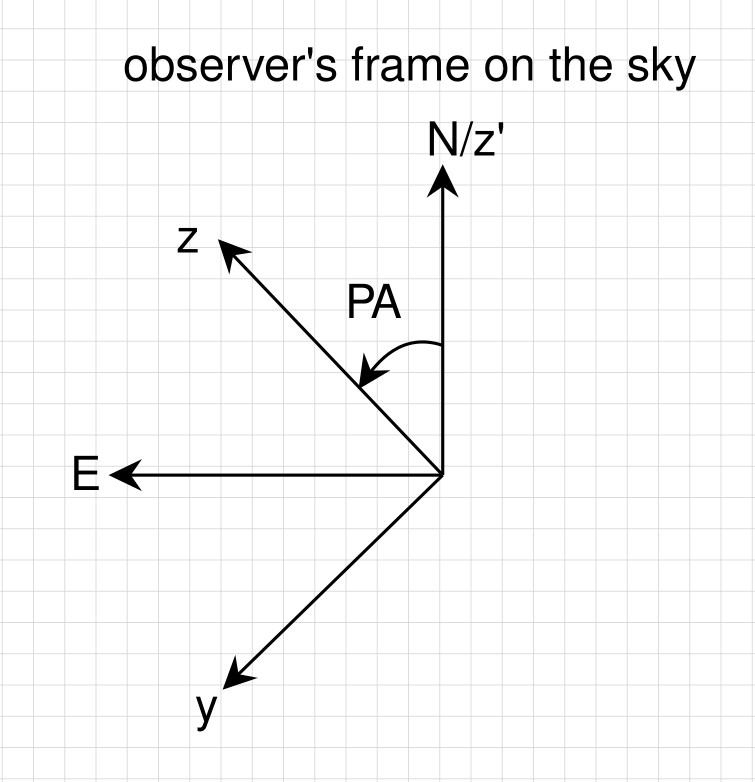
Fig.1 Rotation of the BLR coordinate (YOZ) with a position angle (PA) to the observer’s coordinate on the sky (Y’OZ’/EON).#